Background of the Case
The Gauhati High Court dismissed a criminal petition filed by M/s Naman Enterprise seeking to quash a cheque dishonour complaint instituted by M/s Gopi Mohan Drug Distributor under Section 138 of the Negotiable Instruments Act, 1881.
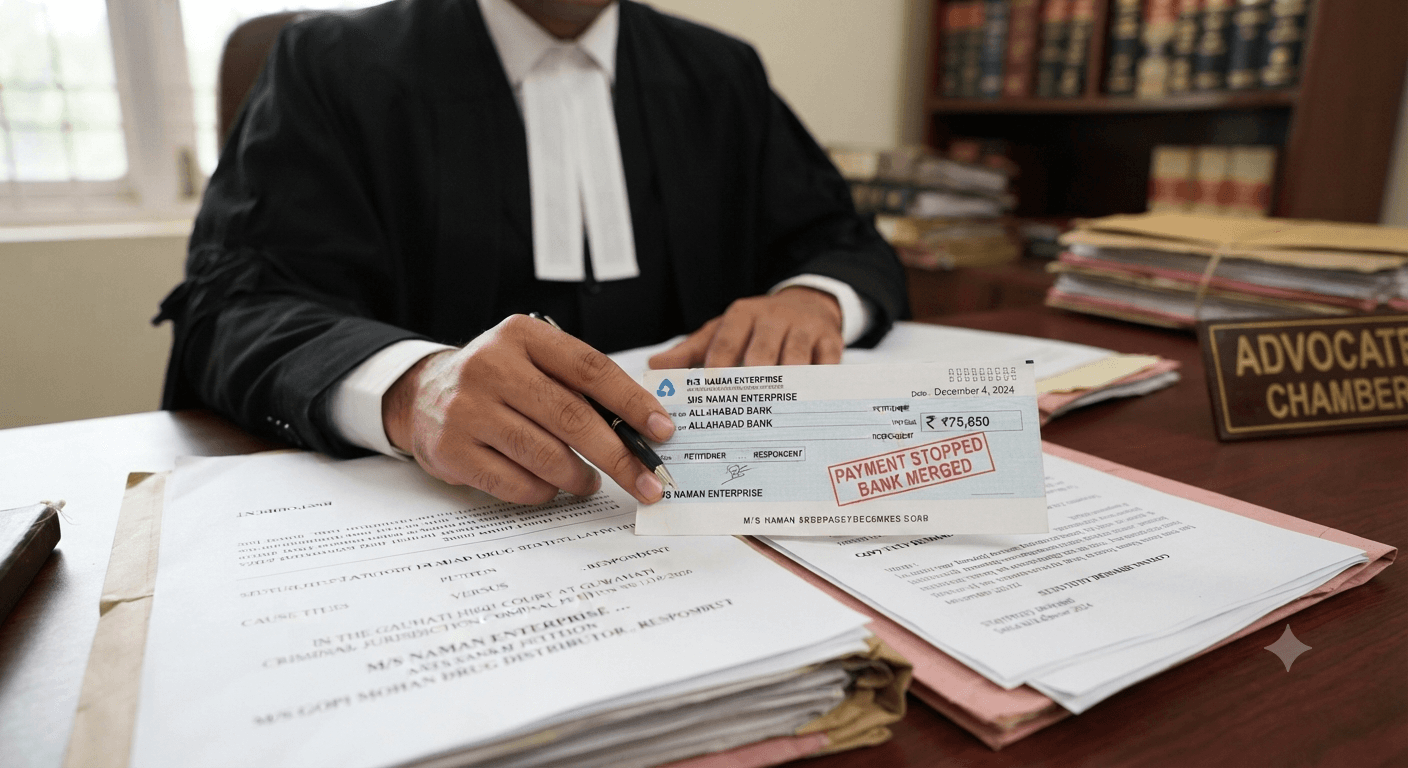
The dispute arose from business transactions involving the supply of medicines and surgical items on credit. The complainant alleged that ₹75,650 remained unpaid and that the petitioner issued a cheque dated December 4, 2024, drawn on the erstwhile Allahabad Bank, towards repayment.
However, the cheque was returned unpaid by Indian Bank with the endorsement "Bank merged". Despite receiving a statutory demand notice, the petitioner allegedly failed to make payment within 15 days.
Petitioner's Arguments
The petitioner contended that the cheque had been issued years earlier as security and that no legally enforceable debt remained outstanding. It further argued that Allahabad Bank had merged with Indian Bank with effect from April 1, 2020, rendering its earlier cheques invalid and making prosecution under Section 138 legally unsustainable.
Court's Observations
Justice Shamima Jahan observed that the complainant could not reasonably be expected to know the legal or contractual consequences of the merger or whether Indian Bank was obligated to honour cheques issued by customers of the erstwhile Allahabad Bank.
The Court held that such matters fell within the knowledge of the concerned banking institutions and that the bank merger, by itself, could not constitute a ground for quashing proceedings under Section 138.
Relying on the Supreme Court's decision in Laxmi Dyechem v. State of Gujarat, the Court noted that cheque dishonour for reasons beyond the specifically mentioned grounds of insufficiency of funds could also attract Section 138, depending on the circumstances.
The Court also referred to decisions of the Bombay and Punjab and Haryana High Courts concerning cheque dishonour following bank mergers.
It further observed that whether the cheque represented an existing legally enforceable debt or had merely been issued as security were disputed questions requiring examination during trial.
The statutory presumption under Section 139 of the NI Act that a cheque was issued towards discharge of a debt or liability would also have to be considered, subject to rebuttal by the accused.
Final Decision
The High Court refused to quash the complaint and dismissed the criminal petition. It left the questions concerning the validity of the cheque, existence of legally enforceable debt and alleged security arrangement to be determined by the trial court on the basis of evidence.
Case Details
Case Name: M/s Naman Enterprise v. The State of Assam and Another
Court: Gauhati High Court
Date of Decision: November 11, 2026
Case Number: Criminal Petition No. 1219 of 2026
Coram: Justice Shamima Jahan