Background of the Case
The Gujarat High Court was dealing with a writ petition filed by Bhumikaben, who challenged an order passed by the Collector, Ahmedabad, rejecting her application seeking permission to use agricultural land for non-agricultural (NA) purposes under Section 65 of the Gujarat Land Revenue Code, 1879.
The dispute arose from repeated rejection of the petitioner's application on the ground that certain earlier transactions involving the land had allegedly taken place without obtaining permission under Section 63 of the Gujarat Tenancy and Agricultural Lands Act.
The Collector had relied upon adverse opinions given by the Mamlatdar and Agricultural Lands Tribunal (ALT) and the Deputy Collector (Land Reforms).
Earlier Proceedings Before the High Court
The petitioner had initially submitted an application under Section 65 of the Gujarat Land Revenue Code on 19 December 2024. The Collector rejected the application on 11 February 2025, primarily relying upon the alleged absence of permission under Section 63 of the Tenancy Act in earlier transactions concerning the property.
Aggrieved by the rejection, the petitioner approached the Gujarat High Court by filing Special Civil Application No. 3097 of 2025.
By an order dated 2 March 2026, the High Court allowed the petition and quashed the Collector's order. The Court held that the Collector had exceeded the scope of authority available under Section 65 by examining issues relating to the validity of earlier transactions and the title of the applicant.
The Court directed the petitioner to submit a fresh application for NA permission and instructed the Collector to decide it within the prescribed statutory period, keeping in view the principles laid down in Tusharbhai Harjibhai Ghelani v. State of Gujarat, reported in (2019) 4 GLR 2578.
Scope of the Collector's Powers Under Section 65
The earlier decision clarified the limited nature of the inquiry contemplated under Section 65 of the Gujarat Land Revenue Code.
The provision primarily requires the Collector to examine whether the applicant is an occupant of the land and whether the land is assessed or held for agricultural purposes.
The Court explained that the relevant considerations include the applicant's occupation of the land and the nature of its existing use. The provision does not confer jurisdiction upon the Collector to undertake an independent adjudication of complicated questions concerning ownership or title.
Where a serious dispute regarding title arises, the appropriate course is to leave the parties to approach the competent civil court rather than allowing the Collector to decide such disputes while considering an NA permission application.
The Court had also relied upon the Supreme Court's decision in State of Gujarat v. Patel Raghav Natha, (1969) 2 SCC 187, which clarified that revenue authorities should not adjudicate serious disputes concerning title to immovable property.
Repeated Rejection Despite Earlier Judicial Directions
Following the High Court's order dated 2 March 2026, the petitioner submitted a fresh application on 7 April 2026, which was acknowledged by the authorities on 11 April 2026.
The petitioner also submitted a representation on 2 April 2026, specifically bringing the earlier judicial directions to the Collector's attention.
However, the Collector again rejected the application by an order dated 6 August 2026.
The reasons substantially repeated the earlier grounds, including negative opinions of the ALT and Deputy Collector (Land Reforms) concerning the previous transactions and alleged non-compliance with the Tenancy Act.
The Collector's order also referred to the possibility of filing a Letters Patent Appeal against the High Court's earlier decision and stated that a proposal had to be submitted to the Government in that regard.
The petitioner pointed out that the State had not actually filed any such appeal, despite more than seven months having elapsed since the earlier decision.
Consequently, the petitioner was once again compelled to approach the High Court, contending that the Collector had disregarded the earlier judicial directions and subjected her to unnecessary litigation.
Submissions on Behalf of the State
Before the High Court, the State Government defended the Collector's action by submitting that the authorities were in the process of filing a Letters Patent Appeal against the earlier order.
The State's counsel, however, admitted that no such appeal had been filed as on the date of the present proceedings.
It was further submitted that if the petitioner were directed to approach the Collector again with a fresh application, the authorities would consider it in accordance with the Revenue Department's circular dated 7 October 2026.
High Court's Observations on Disobedience of Judicial Orders
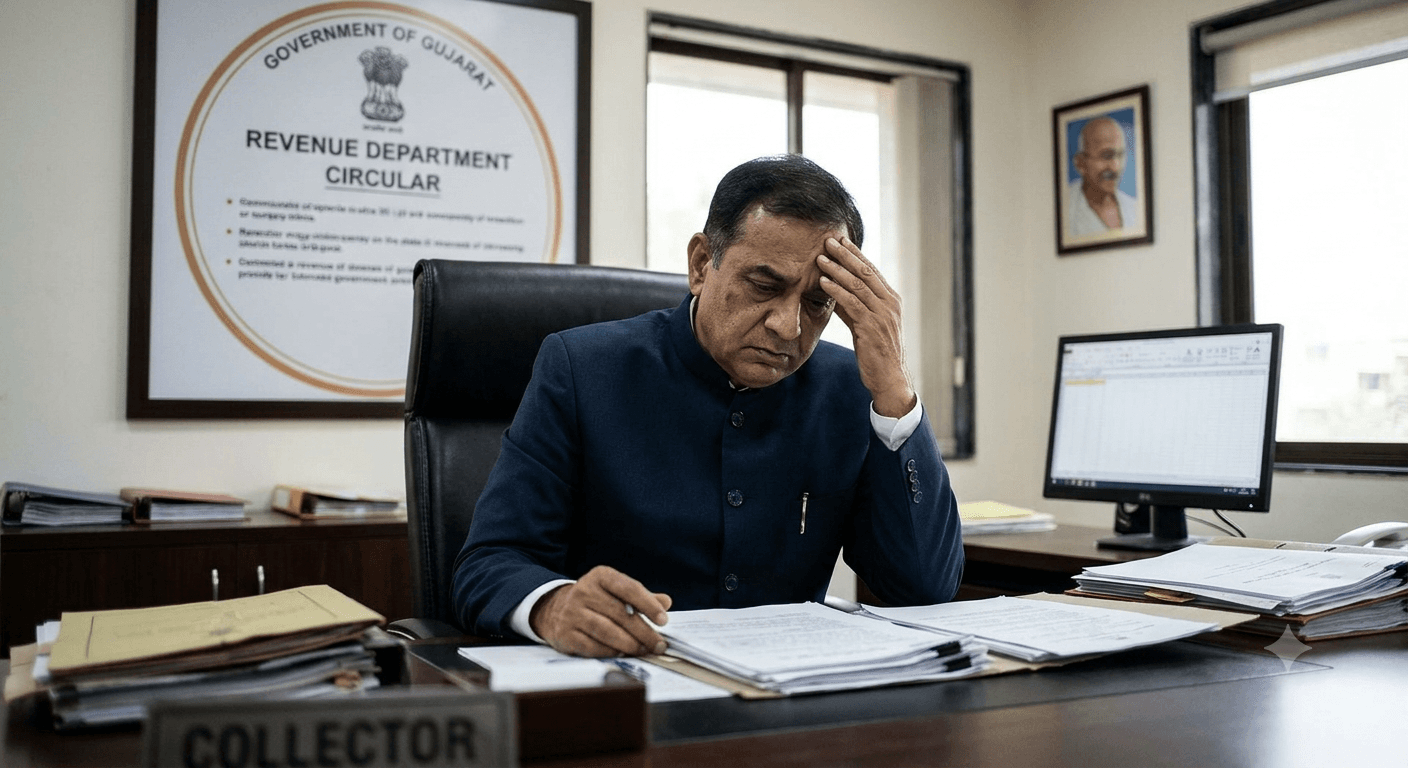
Justice M. K. Thakker took serious exception to the Collector's conduct.
The Court observed that the Collector had once again rejected the application on substantially the same grounds that had already been rejected by the High Court. This was done despite a specific direction to reconsider the application within the statutory period of 90 days.
The Court also took note of the fact that the Collector had relied upon the proposed filing of an appeal as justification for his action, even though no appeal had actually been instituted.
The Court emphasised that every individual and public authority is under an obligation to respect and comply with judicial orders. Government departments and their officials cannot claim exemption from this fundamental requirement.
It further observed that when a court prescribes a specific period for compliance, the concerned authority must adhere to that timeline.
If any genuine difficulty prevents compliance with a judicial direction, the appropriate course is to approach the court promptly and seek suitable relief through the legal remedies available.
An authority cannot simply disregard a judicial direction on the assumption that an appeal may be filed at some future date.
The Court made the following significant observation:
"Where the Government departments neither obeys the order nor approach to the Court in time, then only possible inference in law is that such party disobeys the order of the Court. In other words, intentionally not carrying out the order of the Court. Flagrant violation of the Court's order would reflect the attitude of the officer concerned to undermine the authority of the Courts, its dignity and the administration of justice."
The Court specifically held that, in the present case, such an inference was required to be drawn against the Collector.
Revenue Department Circular Could Not Override Judicial Directions
The State also relied upon a Revenue Department circular dated 7 October 2026 to justify reconsideration of the matter by the Collector.
The High Court rejected this justification, observing that the circular had been issued after the Collector had passed the impugned order dated 6 August 2026.
More importantly, the Court clarified that the circular did not introduce any new statutory provision or enact any law. It merely contained administrative directions requiring authorities to act in accordance with the applicable legal principles and judicial decisions.
An administrative circular could not therefore be relied upon to justify an action contrary to an existing judicial direction.
Personal Cost of ₹1 Lakh Imposed on the Collector
Taking note of the repeated disregard of its directions and the unnecessary hardship caused to the petitioner, the High Court held that the consequences of such conduct should not be borne by the litigant.
The Court observed that the petitioner had been repeatedly compelled to approach the same authority and return to the High Court because the Collector had failed to act in accordance with the law and the earlier judicial order.
In particularly strong terms, the Court remarked:
"This is not the first instance where the Collector has acted as a superpower authority and considering himself as a person, who can act according to his own whims and wish."
The Court further observed:
"In the opinion of this Court, the hardship which is caused to the litigants is required to be compensated by Collector himself from his own pocket."
Accordingly, the Court imposed litigation costs of ₹1,00,000 on the Collector, directing that the amount be paid from his personal salary rather than being treated as an ordinary expense of the Government.
The Court further clarified that if the Collector failed to deposit the amount within the prescribed period, the State authorities would have to deposit it and subsequently recover the amount from the Collector's salary.
The amount is directed to be paid to the petitioner after verification through electronic transfer.
Final Decision of the High Court
The Gujarat High Court allowed the writ petition and issued the following directions:
1. The Collector's order dated 6 August 2026 rejecting the petitioner's NA permission application was quashed and set aside.
2. The petitioner's application dated 11 April 2026 was restored to its original file.
3. The Collector was directed to reconsider the application in accordance with the earlier decision rendered in Special Civil Application No. 3097 of 2025 and decide it within the prescribed statutory period.
4. The Collector was directed to deposit litigation costs of ₹1,00,000 from his own salary before the Registry within one month.
5. In the event of failure to deposit the amount, the State authorities were directed to make the payment and recover the same from the Collector's salary.
The Court thus ensured that the petitioner received compensation for the unnecessary hardship and repeated litigation caused by the failure of the public authority to comply with judicial directions.
Legal Significance
The decision reinforces the principle that judicial orders are binding on executive authorities and must be implemented in both letter and spirit.
A government official cannot disregard a court's directions merely because the Government is considering an appeal. Unless the order is stayed or modified by a competent court, the authority remains bound to comply with it.
The decision also highlights the distinction between administrative authority and judicial authority. Public officials must exercise statutory powers within the limits prescribed by law and cannot use administrative proceedings to reopen issues that have already been decided by a competent court.
The imposition of personal costs is particularly significant. It demonstrates that courts may hold an individual public official financially accountable where the official's conduct causes avoidable hardship to litigants through disregard of judicial directions.
The decision serves as a reminder that public authorities are equally bound by the rule of law and that the burden of an official's arbitrary or unjustified conduct should not automatically fall upon an ordinary litigant or the public exchequer.
Case Details
Case Name: Bhumikaben D/o Janakkumar B. Brahmbhatt W/o Chirag Rajndrakumar Rao v. Collector, Ahmedabad & Another
Court: High Court of Gujarat at Ahmedabad
Date of Decision: 5 November 2026
Case Number: Special Civil Application No. 13992 of 2026
Neutral Citation: 2026:GUJHC:71914
Coram/Judge: Justice M. K. Thakker