Property Transactions Below Stamp Duty Value: Sections 78, 53 & 92 of the Income-tax Act, 2025
The price agreed between a property buyer and seller may differ from the value adopted for stamp duty purposes. Such a difference can have income-tax consequences for both parties, even where the transaction is genuine and the agreed consideration is fully documented.
Under the Income-tax Act, 2025, the relevant provisions are Section 78 (capital assets), Section 53 (business inventory) and Section 92(2)(m)(ii) (buyer or recipient). The Act came into force on 1 April 2026.
Consideration and Stamp Duty Value
Consideration refers to the agreed transaction price. Under Section 2(105), stamp duty value means the value adopted, assessed or assessable by the relevant government authority for payment of stamp duty on immovable property.
The term "assessable" also includes the value that the authority would have adopted if the property had been referred to it for stamp duty valuation. Therefore, the income-tax assessment is not restricted to the value expressly mentioned in the sale deed.
Which Provision Applies?
The applicable provision depends on the nature of the property and the person concerned.
Section 78 – Seller: Applies to the transfer of land or building held as a capital asset.
Section 53 – Seller: Applies to the transfer of land or building held otherwise than as a capital asset, typically business inventory or stock-in-trade.
Section 92(2)(m)(ii) – Buyer or Recipient: Applies to the receipt of qualifying immovable property without consideration or for inadequate consideration.
The seller's classification of the property determines whether Section 78 or Section 53 applies. The buyer's tax liability must be examined separately.
Section 78: Seller Holding a Capital Asset
Section 78 provides for the substitution of stamp duty value for actual consideration while computing capital gains under Section 72, subject to the prescribed safeguards.
Under Section 78(1)(b), the actual consideration is accepted where the stamp duty value does not exceed 110% of the consideration. If this limit is exceeded, the stamp duty value is ordinarily treated as the deemed consideration.
It is important to note that the deemed consideration is only the starting point for computing capital gains and does not itself represent the taxable capital gain.
Section 53: Seller Holding Business Inventory
Section 53 applies to land or buildings held otherwise than as capital assets, such as property held by a developer as stock-in-trade.
The provision requires the substitution of stamp duty value for actual consideration while computing business profits, subject to the prescribed conditions.
Section 53(2) preserves the actual consideration where the stamp duty value does not exceed 110% of the consideration.
Section 92: Tax Consequences for the Buyer
Under Section 92(2)(m)(ii)(B), the difference between the stamp duty value and the actual consideration is taxable as income from other sources if it exceeds the higher of:
₹50,000; or
10% of the consideration.
Once this threshold is crossed, the entire difference becomes taxable, subject to applicable exceptions and valuation relief. The tolerance limit is not deductible from the taxable difference.
Where immovable property is received without consideration, Section 92(2)(m)(ii)(A) generally provides for taxation of the entire stamp duty value if it exceeds ₹50,000.
Practical Examples
The following examples assume that no exemption, agreement-date relief or valuation adjustment applies.
Example 1: Consideration – ₹50 lakh; Stamp Duty Value – ₹54 lakh
Seller: Actual consideration of ₹50 lakh is accepted.
Buyer: No addition to taxable income, as the difference does not exceed the applicable threshold.
Example 2: Consideration – ₹50 lakh; Stamp Duty Value – ₹55 lakh
Seller: Actual consideration of ₹50 lakh is accepted.
Buyer: No addition to taxable income, as the difference does not exceed the applicable threshold.
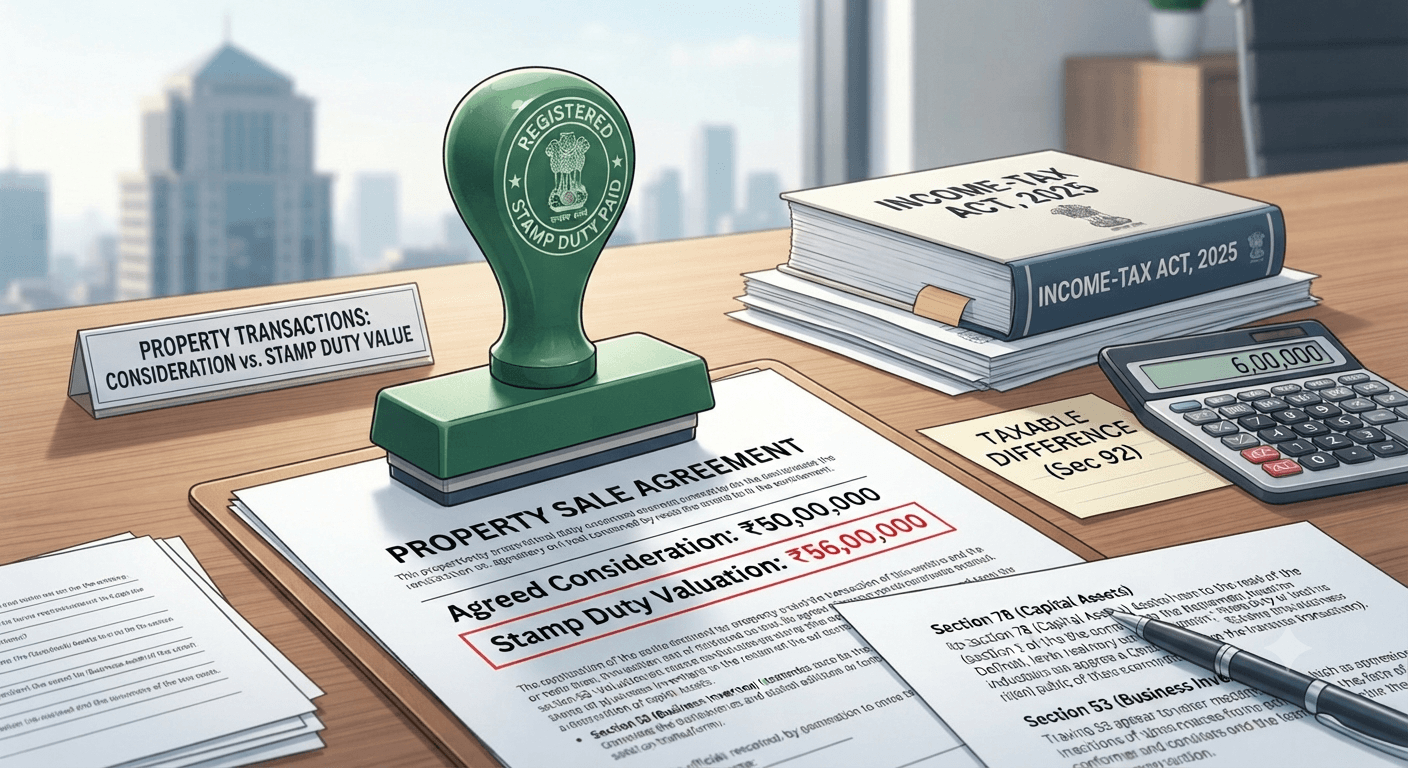
Example 3: Consideration – ₹50 lakh; Stamp Duty Value – ₹56 lakh
Seller: ₹56 lakh is treated as deemed consideration for computing capital gains or business profits, as applicable.
Buyer: The entire difference of ₹6 lakh is taxable as income from other sources.
Example 4: Consideration – ₹4 lakh; Stamp Duty Value – ₹4.45 lakh
Seller: ₹4.45 lakh is treated as deemed consideration.
Buyer: No addition to taxable income, as the difference of ₹45,000 does not exceed ₹50,000.
These examples illustrate how the tax consequences can differ between the buyer and seller.
The 10% calculation is based on the actual consideration. For instance, where the consideration is ₹50 lakh, the general seller-side tolerance ceiling is ₹55 lakh.
Agreement Date and Registration Date
Where the agreement date and registration date differ, Sections 53(3) and 53(4) permit the adoption of the stamp duty value as on the agreement date, provided the prescribed conditions are satisfied, including receipt of the whole or part of the consideration through a qualifying payment mode on or before the agreement date.
For the buyer, Section 92(4)(a) similarly provides for the adoption of the agreement-date stamp duty value where the statutory conditions are fulfilled, including timely payment through specified banking or electronic modes.
Section 66(32) defines the qualifying payment modes, which include:
Account-payee cheque;
Account-payee bank draft;
Electronic clearing system through a bank account; and
Prescribed electronic payment modes.
A cash advance does not satisfy this definition.
Section 78(1)(a) provides corresponding agreement-date relief in respect of capital assets.
Disputing an Excessive Stamp Duty Valuation
Section 78(2) permits a reference to a Valuation Officer where the taxpayer claims that the stamp duty value exceeds the fair market value, subject to the statutory conditions relating to a separate valuation challenge.
Under Section 78(3), where the Valuation Officer determines a value higher than the stamp duty value, the deemed consideration cannot exceed the stamp duty value.
Section 53(5) extends the mechanism under Section 78(2) and (3) to business assets. The corresponding valuation-reference mechanism for buyers is contained in Section 92(4)(b).
Exceptions for Specified Receipts
Section 92(3) provides certain exceptions from taxation, including qualifying receipts:
From specified relatives;
On the occasion of an individual's marriage; and
Under a will or inheritance.
The term "relative" is defined under Section 92(5)(g). Therefore, an ordinary family relationship will not automatically qualify for the exemption unless it falls within the statutory definition.
Precautions Before Completing a Property Transaction
Buyers and sellers should carefully compare the agreed consideration with the applicable stamp duty value before completing a property transaction.
They should also:
Identify the correct tax classification of the property.
Preserve the agreement and supporting payment records.
Maintain relevant valuation documents.
Examine whether agreement-date relief is available.
Obtain supporting evidence of any property-specific disadvantages when disputing an excessive valuation.
The income-tax tolerance limit does not reduce the stamp duty payable on the transaction. Stamp duty liability and income-tax liability must be examined independently.
This article provides general legal information under the Income-tax Act, 2025. The applicable tax year, statutory conditions and transaction documents should be examined before determining the actual tax liability.
CA Vijayakumar Shetty
Chartered accountant |
Mangalore
+91 98450 82430
cavkshetty@gmail.com