Background of the Case
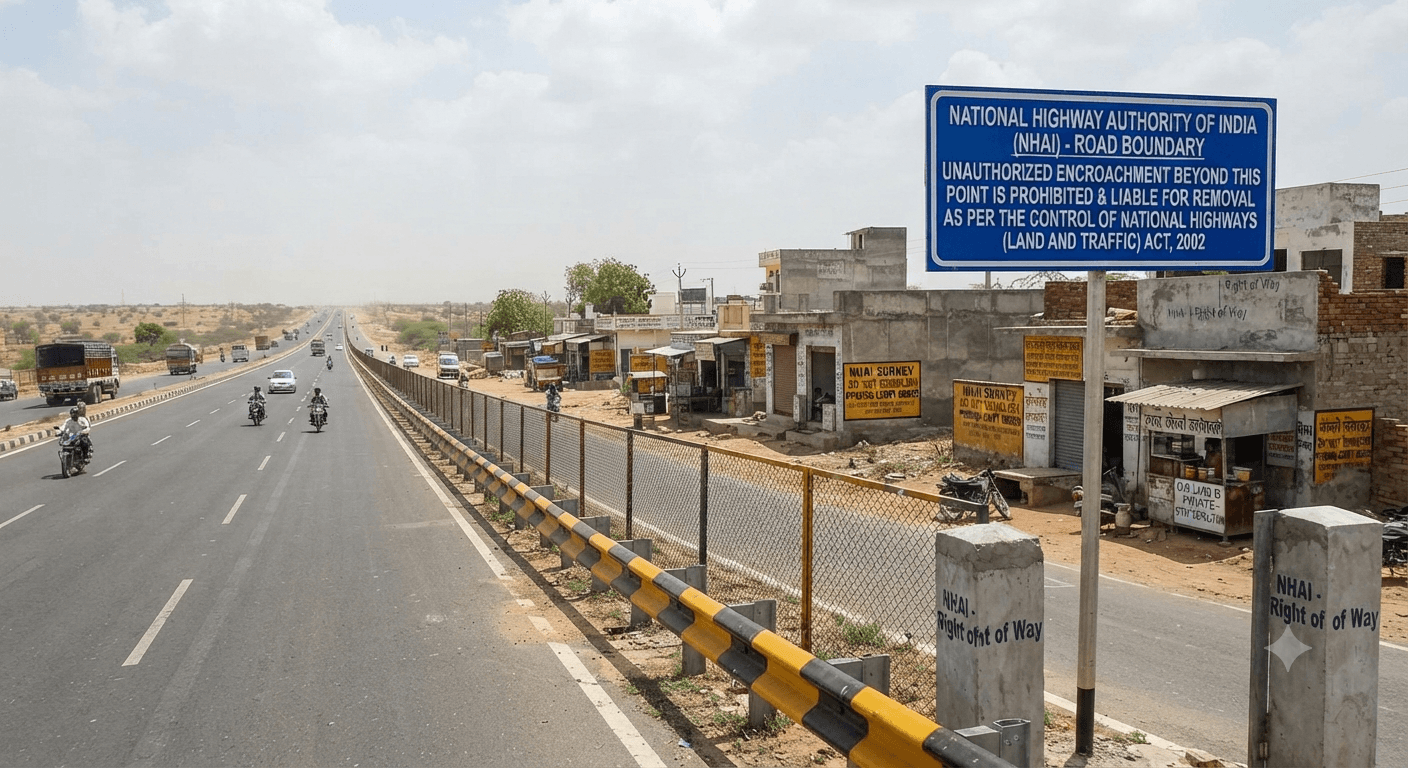
The Supreme Court was considering a batch of applications filed by property owners challenging demolition notices issued by the National Highways Authority of India (NHAI) and other authorities.
The dispute arose after the Supreme Court, by its order dated April 13, 2026, issued directions for identifying and removing unauthorised encroachments along National Highways in the interest of road safety, following serious road accidents, including the Phalodi accident in Rajasthan.
Several property owners subsequently approached the Supreme Court, claiming that their structures stood on privately owned land and that the authorities had incorrectly included their properties within the Right of Way (ROW) of National Highways.
They disputed the land demarcation, acquisition proceedings and the extent of highway boundaries, alleging that demolition action was being initiated without properly determining their rights.
NHAI's Arguments
NHAI contended that the removal of unauthorised structures was being undertaken in compliance with the Supreme Court's earlier directions. It also submitted that notices had been issued under the Control of National Highways (Land and Traffic) Act, 2002, and that official measurements established that the disputed structures fell within the highway's Right of Way.
Supreme Court's Observations
A Bench comprising Justice Vikram Nath and Justice Aparesh Kumar Singh clarified that its earlier directions concerning highway encroachments did not determine whether individual properties constituted unauthorised encroachments.
The Court observed:
"The directions issued by this Court cannot be invoked as an independent justification for dispensing with the requirements of the statute."
Referring to Section 26 of the 2002 Act, the Court explained that the statutory procedure ordinarily requires identification of the highway land, issuance of notice, an opportunity to submit representations and consideration of the affected person's objections.
It also acknowledged that Sections 26(7) and 26(8) permit removal without prior notice in specified circumstances, but clarified that such powers must be exercised subject to the statutory conditions.
The Court further observed that neither a mere claim of ownership by an individual nor an assertion by authorities that a property falls within the Right of Way can conclusively determine the dispute. Such competing claims must be examined through the applicable legal procedure.
Final Decision
The Supreme Court permitted the affected property owners to approach their respective jurisdictional High Courts for adjudication of their grievances.
It directed that existing interim protection would continue until the High Courts disposed of the proceedings. In cases where no interim protection had previously been granted, NHAI and other authorities were restrained from demolishing or removing the disputed structures or taking coercive action pursuant to the challenged notices until disposal of those proceedings.
The Court clarified that this protection was limited to the structures involved in the applications and did not authorise fresh construction or encroachment. Its earlier directions for removing unauthorised highway encroachments otherwise remained in force.
Case Details
Case Name: In Re: Phalodi Accident v. National Highways Authority of India & Others
Court: Supreme Court of India
Date of Decision: November 18, 2026
Case Number: Suo Motu Writ Petition (Civil) No. 9 of 2025 and connected matters
Coram: Justice Vikram Nath and Justice Aparesh Kumar Singh