FIR Against Officials and Property Owners
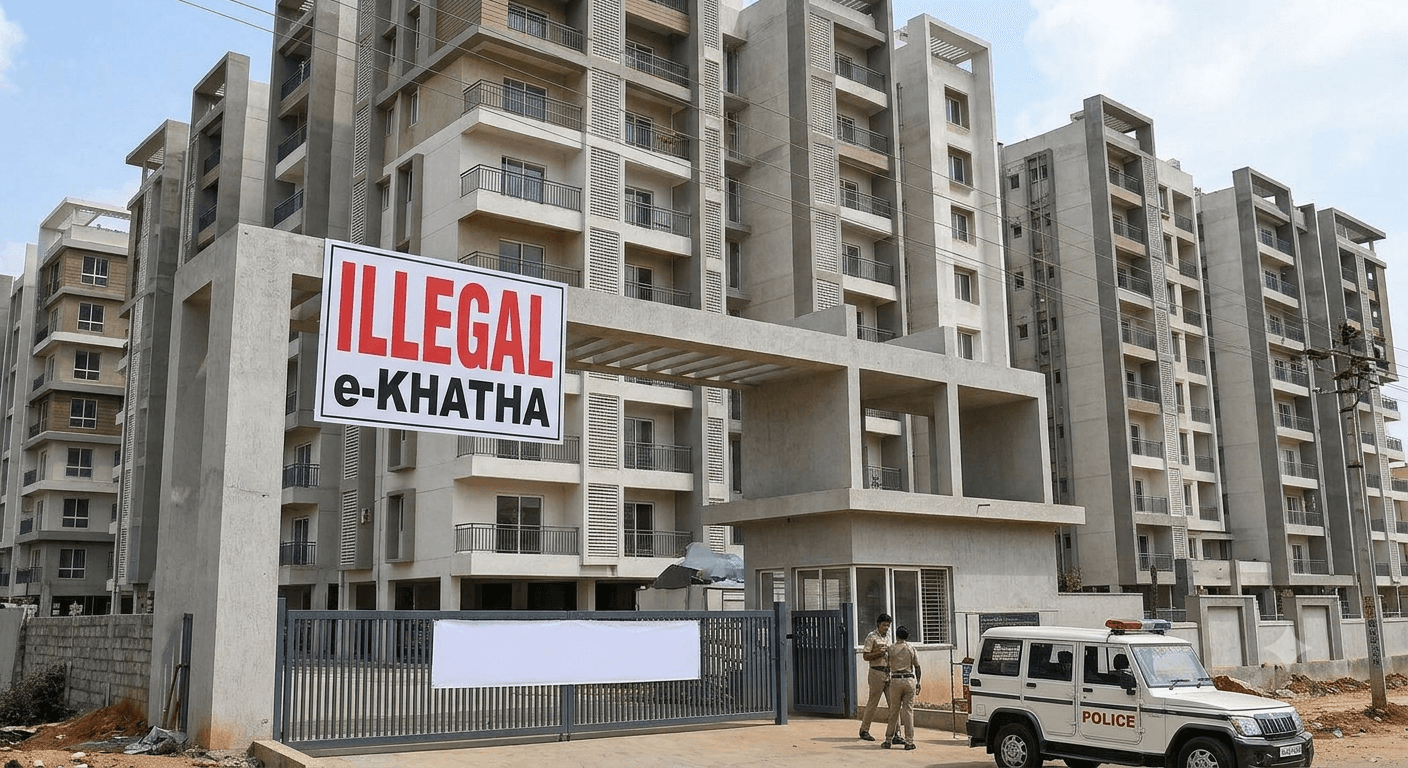
Bengaluru police have registered a criminal case against two Greater Bengaluru Authority (GBA) revenue officials and 32 property owners over alleged irregularities in the issuance of e-Khatas to newly constructed flats.
The FIR was registered on November 9, 2026, at Halasuru Gate Police Station, following a complaint by Munish Moudgil, Special Commissioner (Revenue and IT), GBA. The complaint alleges that the officials and private applicants colluded to obtain e-Khatas by misusing a provision in the e-Aasthi software.
Alleged Misuse of SARFAESI Module
According to the complaint, a technical examination revealed that 98 ineligible properties in KR Puram and Horamavu had been granted new e-Khatas between January 29 and June 19.
The irregularities allegedly involved misuse of the SARFAESI module, which is intended exclusively for issuing e-Khatas to properties auctioned by banks and financial institutions following loan defaults.
Instead of the mandatory bank-issued sale certificates, applicants allegedly uploaded ordinary sale deeds, joint development agreements and building licences to obtain the approvals.
Role of Revenue Officials
Basavaraj Magi and Lokamatha, Assistant Commissioners and in-charge Revenue Officers of the KR Puram and Kengeri divisions respectively, have been named in the FIR.
The complaint alleges that both officials used their official login credentials to approve the applications despite adverse reports submitted by revenue inspectors in 31 cases.
Apart from the officials, 32 property owners have also been named for allegedly conspiring with them to secure the irregular approvals.
Criminal Investigation
The case has been registered under various provisions of the Bharatiya Nyaya Sanhita (BNS) relating to criminal conspiracy, cheating, criminal breach of trust and forgery.
The investigation will examine the individual roles of the property owners, including whether they knowingly participated in obtaining the allegedly illegal approvals.
The case is significant because the criminal proceedings extend beyond the government officials who processed the applications to the private beneficiaries who allegedly obtained the approvals.